


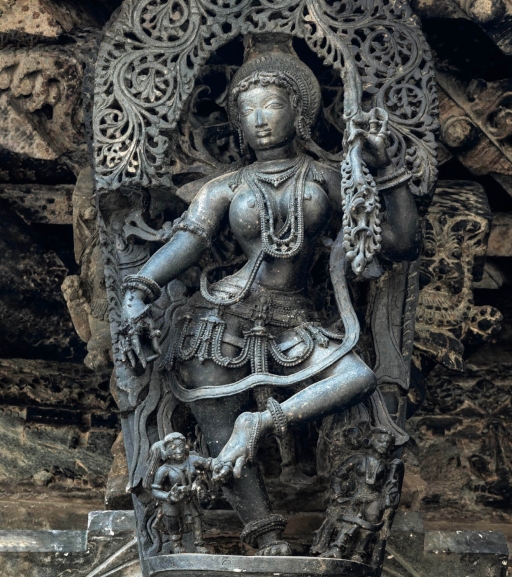
From the Field to Conservation: The Deccani Studies Journey
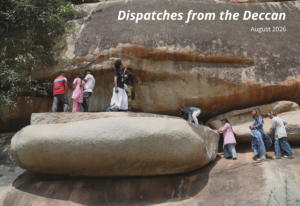
The second edition of the Deccani Studies Program has come to a close after four weeks of fieldwork. It took a group of undergraduate students on an immersive exploration to help them understand the Deccan as a multifaceted region with an overlapping and layered history. Through site visits, lectures and hands-on conservation training, students worked alongside leading scholars and practitioners across architecture, history, archaeology and conservation.
The DHF also raised funds to support student scholarships for the program, broadening access. We would like to thank the Harish & Bina Shah Foundation (HBSF) and Ashoka University for partnering with us on this important initiative and for helping make the Deccani Studies Program possible. We are also grateful for the generous support of Mr. and Mrs. Subhedar and Dr. and Mrs. Kommareddi.
Banner image: Prehistoric rock art and cave painting site at Onake Kindi Caves, Karnataka. Photograph by Sai Charan Palakurthi.
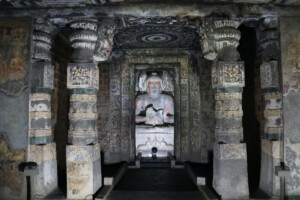
Ajanta Caves, Maharashtra. Photograph by Sai Charan Palakurthi.
From Ajanta to Badami and Shravanabelagola
Over the course of four weeks, students moved from Ajanta’s Buddhist rock-cut caves to the Sultanate region, where they encountered the architecture of power. At Badami, Aihole and Pattadakal, they traced the evolution of the Dravida temple and its hybrid forms before witnessing the remnants of the monumental Vijayanagara Empire at Hampi. The journey then took them to the restrained expression of Jaina sites at Shravanabelagola and Mudabidri, and finally to the royal splendour of Mysuru’s Wadiyar period.
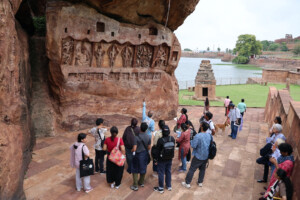
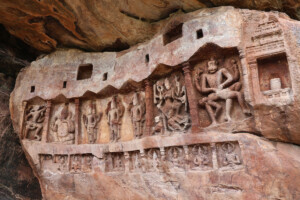
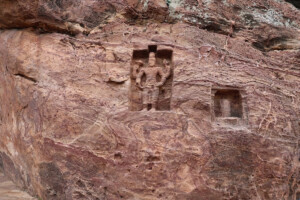
7th-8th century open-air rock-cut relief panels near the Bhutanatha Group of temples, Badami, Karnataka. Photograph by Sai Charan Palakurthi.
From the Field to Conservation
The last stop was Jayalakshmi Vilas Mansion (JVM), the DHF’s ongoing project, where participants gained first-hand exposure to restoration and conservation in progress. At JVM, they explored the building and its departments, learning about conservation, restoration and documentation practices, alongside sessions on the economics of heritage restoration, cultural economics and preserving cultural heritage through digital means. The program culminated in an assignment where participants were assigned a topic and developed a project to present during the final days of the program.
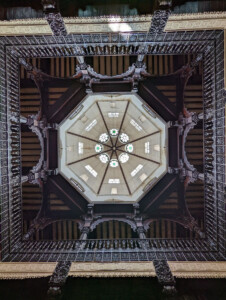
North Block, Jayalakshmi Vilas Manion, Karnataka.
“Nowhere is the glory of Early Chalukya sculptural art better displayed than in the splendid ceilings of temple interiors of Badami, Aihole and Pattadakal.”
– George Michell
(Architectural historian and co-founder of the Deccan Heritage Foundation)
In the field, students observed how the sculptural beauty of monuments and temples was not restricted to temple walls or pillars. Looking up was equally rewarding. Some of the motifs recur across various sites. The nagaraja or King of Serpents is one such motif, as seen below in an imposing sculpture carved on to the ceiling of Cave 1 in Badami, Karnataka.
This coiled serpent, its body encircling a human torso with flying couples at either side, is carved over the central bay. Around it, the ceiling is richly worked, with part-fluted columns, cushion-like capitals and brackets fashioned as open-mouthed makaras, disgorging human figures and yalis.
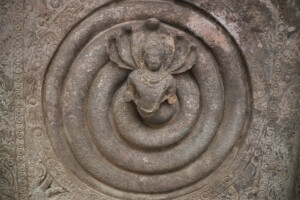
Nagaraja, Cave 1, Badami, Karnataka. Photograph by Sai Charan Palakurthi.
A nagaraja coils beside the wheel with fish-spokes at Aihole, in the inner porch of the Durga Temple. Another nagaraja is carved above the Nandi at Naganathakolla, midway between Mahakuta and Banashankari. At Pattadakal, the Mallikarjuna temple places the nagaraja among three ceiling panels: dancing Shiva accompanied by Parvati and Nandi, the nagaraja with its coiled serpent body, and Lakshmi between elephants within a ring of lotus ornament. Much later, at Hosa Basadi in Mudabidri, the serpent appears in yet another setting: among the snake stones housed in the shrine of the Kshetrapala.
Travel with the DHF
For those interested in planning their own journey through the Deccan, the DHF offers a series of travel guidebooks and curated itineraries developed by our co-founders Helen Philon, George Michell and other leading historians. Available in both print and digital formats, our books provide practical information for exploring the region.
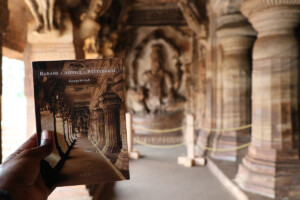
Badami, Karnataka. Photograph by Sai Charan Palakurthi.
Upcoming Lectures in the United States
Our co-founder, Dr. George Michell, who is a leading authority on South Asian architecture will present his lecture on the DHF’s latest publication, City of Victory: Hampi Vijayanagara, his landmark work with the late John M. Fritz, illustrated with photographs by the award winning photographer John Gollings.
Consulate General of India, Chicago, Illinois
Saturday, September 19, 2026
11:00 am
RSVP by September 14, 2026 at pic.chicago@mea.gov.in
Flint Institute of Arts, Flint, Michigan
Wednesday, September 23, 2026
6:00 pm
Register here
City of Victory: Hampi Vijayanagara tells the story of the 14th–16th century capital spread across more than 30 square kilometres of granite boulders and ruins along the Tungabhadra River. The product of over forty years of fieldwork by Michell and Fritz since 1980, it stands as one of the most significant records of the site, for scholars and travellers alike. Get your copy from the DHF Bookstore.
Also available is a limited-edition selection of Gollings’ superb black and white photographs that capture the drama of Vijayanagara’s landscape as well as the architectural forms of its principal monuments and the details of their sculpted reliefs.
Thank you for your continued engagement with the DHF. We look forward to bringing you the latest updates about our ongoing projects, initiatives and publications across the Deccan.

|
|